
Accessible version: high accessible web site


bg dx

Toniolo Educational Centre

The building which houses the Educational Centre was built by Opera della Primaziale Pisana during the large-scale restoration of the ex monastery of the Capuchin nuns, which now houses the Vestry Board Museum (Museo dell'Opera). The Centre, which includes the Historical Archives and the Library, was opened along with the Cathedral Vestry Board Museum in 1986, as a centre for research and the cultural promotional of the Museum and the monuments of the square.
 
The Library

The Library of Opera della Primaziale Pisana consists of approximately 2,000 documents, including volumes and miscellanies, regarding in particular the history of the institute, the monuments of the Square and the history of the city in general. It also includes such important publications as Vite de ' pittori del Vasari (1741), Pisa illustrata by Da Morrona (1812), the Annali Pisani by Tronci (1843). In addition, the Library also owns a large number of dissertation theses on the historical and artistic heritage of the city, the Collana del Bollettino Storico Pisano, I Quaderni dell'Opera, I Quaderni Stefaniani and the Annali della Scuola Normale di Pisa. The Journals section offers further opportunities for research as scholars can consult the Monitore Toscano (1848-1865), the Gazzetta Ufficiale del Regno d'Italia (1865-1870) and Domenica del Corriere (1924-1938).
 
The Historical Archives

The current premises of the Historical Archives of the Vestry Board house paper documents dating back to the early XVIII century. The oldest documents are in the State Archives of Pisa. The archives have been computerised under the Arianna programme, conducted by the Centro di Ricerche Informatiche per i Beni Culturali of Scuola Normale Superiore di Pisa, in conjunction with Società Hyperborea. A large room is available to scholars and researchers for consultation and research.
 
The Photo Archives

The archives consist of approximately 2,000 prints, approximately 1,000 plates and several films. These figures only concern the photographic materials developed from 1860 to the Second World War. Extremely important are the photos of the cycle of Frescos of the Cemetery before the 1945 fire. The collection has always been a scientific point of reference for historians and art historians. In addition, the Archives include a large number of footages of events and works at the Cathedral Square. The plan for computerising all of the documents and developing a video library will end in 2005.
 
Printed iconographic materials

Extremely interesting is the collection of prints, which includes iconographies of the city of Pisa. The oldest ones include two magnificent xylographs of the Liber Chronicarum, which was printed in Nuremberg in 1493. The seventeenth-century collection includes some etched maps published in Amsterdam and Northern Italy, which take their origin from Soli's engraving dating from 1603-1613. The largest group of iconographies dates back to the XVIII and XIX centuries and was engraved by foreign artists who, after coming to Pisa in the wake of the Grand Tour, used to portray the monuments of the Cathedral Square in their views. The iconographies by E. Cresy and G. Taylor, works of a high historical and scientific value, are instead the fruit of studies and accurate measurements. Some Tuscan artists are the authors of some precious engravings of the Square dating from the late eighteenth century. These include the Lucca-born artist Ferdinando Fambrini, the author of a set of fourteen views of Pisa, probably executed with the assistance of painter G. Tempesti and A. Da Morrona, from 1786-87. In addition, the collection includes a set of prints by Ranieri Grassi, a pre-eminent cultural figure in Pisa as well as a very prolific writer and illustrator of the early nineteenth century. Lastly, Lasinio's original drawings and famous engravings of a large part of the Cemetery's frescoes also deserve special attention.
 
The Music Archives

The Music archives consist of a large collection of over nine thousand scores. They include those that have been used between 1600 and 1940 for Mass and holy services in the Cathedral as well as works on the activity carried out from 1940 up to now. Pride of place should be given to the extremely rich repertoire of sacred music: these include masses, motets, antiphons and hymns written between the XVI and the XVII century by Pier Luigi da Palestrina, Marco da Cagliano, Tommaso Lodovico da Victoria and other authors. These documents make up a series of volumes of polyphony, often based on canons, which was typical of church music production back then in Tuscany. In addition, remarkable is the activity of the choirmasters who, by keeping music production to high standards, helped increase the prestige of the "Cappella della Primaziale" ( Choir). Today, compositions of sacred music from the archives are sung again during the concerts held in the Cathedral by the choir.
 
Conference Auditorium

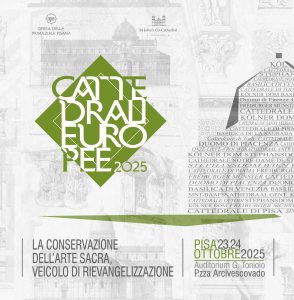
The Auditorium of Opera del Duomo is used for different kinds of meetings and conferences. The facilities can seat up to 150 people and are equipped with audiovisual equipment and a reception room. For further information, log on to Auditorium